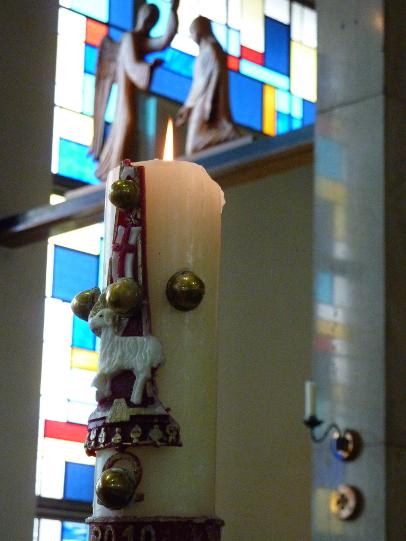
Extract From - http://www.stedwardsromford.org/index.html
Edward the Confessor, as he was known, had not been a particularly successful king,
but his personal character and piety endeared him to his people.
In appearance he is represented as tall, dignified and kindly with
rosy cheeks and a long white beard. He was regarded as a saint
long before he was officially canonized as Saint and Confessor
by Pope Alexander III in 1161. A Confessor is a particular type of saint.
The term applies to those who suffered for their faith
and demonstrated their sanctity in the face of worldly temptations,
but who were not martyrs.
On 13th October {Feast of St. Edward} 1163 in the presence of the King,
Thomas Becket Archbishop of Canterbury and many other
Saxon and Norman Bishops the saint's body was moved to a
resplendent shrine within Westminster Abbey.
King Henry II prepared the shrine.

![]()
Edward the Confessor was born at Islip in Oxfordshire between 1002 and 1005,
the son of King Ethelred the Unready and Emma.
Driven from England by the Danes, and spending his exile in Normandy,
the story goes that Edward vowed that if he should return safely to his kingdom,
he would make a pilgrimage to St Peter's, Rome.
He returned to England and was crowned at Winchester in 1042.
But once on the throne he found it impossible to leave his subjects,
and the Pope released him from his vow on condition that
he should found or restore a monastery to St Peter.
This led to the building of a new church in the Norman style
to replace the Saxon church at Westminster.
Extract From
http://www.westminster-abbey.org/our-history/royals/burials/edward-the-confessor-and-edith
The above illustration depicting St Edward holding his ring and sceptre
is taken from a 14th century manuscript in the Abbey Library

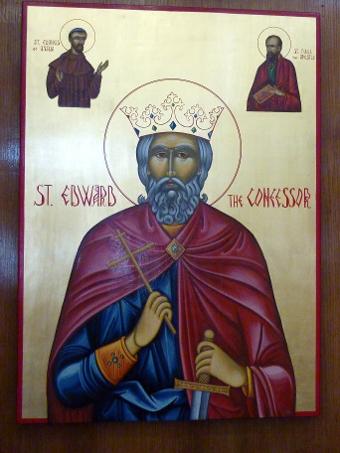
Icon in memory of Frank Maloney
AT WESTMINSTER ABBEY
On 13 October 1163 St Edward’s body was moved, or ‘translated’,
to a Shrine in the church he had built.
On 13 October 1269 his relics were translated to the Shrine
in the present church as part of its Liturgy of Dedication.
Although St Edward’s day of death - the 5th. January - is also commemorated
at Westminster Abbey, the Feast of the Translation
is the principal celebration of St Edward’s life and holiness.
_____
We celebrate his Feast with a Sung Eucharist
and the Abbey bells mark this day by the ringing of a full peal.
Make a free website with Yola